Well, this is one hell of a story. The Everest Trek was one of the most incredible things I've ever done in my life. It may take more than one blog post to adequately describe the 17-day adventure I was just on. I'm just going to start typing and see how far this goes...
*Side note: The over/under on how many heart attacks I give my mother as she reads this is 3.5
There are a lot of ways I can describe the Everest Trek. One way to describe it is painful. I'm currently dealing with the aftermath; a tweaked ankle, a sore knee, cuts and bruises, burnt and blistered skin It was at times excruciating and it pushed me past the limits of what I knew my body was capable of. Still, in spite of all the pain and anguish, I found myself standing at the summit of Kala Pattar, triumphant and proud, staring the world's tallest mountain right in the face.
I never really understood why people climbed mountains. I always figured there must be some kind of existential or cathartic experience people hoped to attain. Perhaps some sense of accomplishment at 'conquering' some of the world's tallest mountains and most inhospitable environments.
Now I don't really know if any of that is true or if it's all bullshit. I don't feel like I conquered anything. I dont think I really had a moment of catharsis. What I do know is that I had a tremendous feeling of accomplishment when I arrived back in Kathmandu, and the indescribable feeling I had at the summit of Kala Pattar--16 days after I departed Kathmandu for that very spot--was one of the best I've ever had in my life.
I arrived in Kathmandu on April 14th with my English friend Colin Fairbank. He's nearing the end of his round-the-world adventure, and figured a trek in Nepal might be a fun way to end it. I'm on my way to Europe to spend a little time there before my trip is over, and figured stops in Nepal and Turkey would be a fun route to take.
In Kathmandu we stayed in the Thamel area, which was eerily reminiscent of the backpacker-frenzied Khao San Road in Bangkok, which I was not particularly fond of. As it turned out, I enjoyed my time in Thamel much more than Khao San Road.
In Thamel, Colin and I met up with Wim Gielis, a nice Belgian guy I met in Kuala Lumpur and who Colin had met in the Chiang Mai area of Thailand. Although he looks like a beast, Van-Damme like, buzz-cut, and standing at 6'3, 220lbs, he was an exceptionally nice guy who became a great friend over the course of the trip.
The three of us purchased the Lonely Planet Guide: Trekking in the Nepal Himalaya to try to figure out exactly what kind of adventure we were after. After debating the Annapurna Circuit (25 days, or 10 at its shortest, and supposedly the most beautiful), the Manaslu Circuit (2 weeks, high altitude, and interesting because we had nicknamed Manaslu 'Sexy Mountain' after seeing photographs of the summit), or the Everest Circuit (23-40 days depending on the route, extreme altitude).
That day, we were walking in search of a place to get some MoMos (a local dish, much like a super delicious dumpling) when Wim suddenly broke formation to follow two gorgeous ladies into a restaurant. We followed him in and sat down. The place was called OR2K and was a vegetarian restaurant. Normally eating at a vegetarian restaurant would be against everything I believe in as a human being, but noting the clientele (beautiful Israeli women), we became frequent patrons.
That first day, however, we didn't meet any Israeli women. We did, however, meet a Canadian named Dan Baum and a former Israeli special forces medic named Eran Sheffer. These two guys would join our group and create our very international trekking team: United States (me), England (Colin), Belgium (Wim), Canada (Dan), and Israel (Eran).
After a few days of thinking it over and discussing, we decided to to the Everest Region trek. We had two options of how to enter the region:
1. We fly from Kathmandu 35 minutes to land at Lukla, the World's Most Dangerous Airport, where there were two fatal crashes in 2010 alone
2. We take a bus from Kathmandu to Shivalaya and walk from there to Everest, a trip that would require an additional 7 days of trekking.
We weighed the options and made our decision primarily because it was believed that we would be much fitter and better acclimatized for the Everest trek if we chose the second option. That belief would turn out to be true. Days 7-17 and the summit of Kala Pattar were easy in comparison to our first 7 days on the trail.
We bought equipment, stripped our packs to the bare essentials, and prepared to set out on what would become the most epic adventure of any of our lives.
As we prepared, Colin gave us some advice as he had the most experience by far. He had experience in mountaineering, summiting 6400m Illumani Peak in Bolivia and a 5500m peak in Huaraz, Peru, as well as trekking, completing the Great Ocean Walk from Apollo Bay to the 12 Apostles, Australia (a distance of over 100km) in only 3 days time.
A side note on the hike:
*Side note: The over/under on how many heart attacks I give my mother as she reads this is 3.5
There are a lot of ways I can describe the Everest Trek. One way to describe it is painful. I'm currently dealing with the aftermath; a tweaked ankle, a sore knee, cuts and bruises, burnt and blistered skin It was at times excruciating and it pushed me past the limits of what I knew my body was capable of. Still, in spite of all the pain and anguish, I found myself standing at the summit of Kala Pattar, triumphant and proud, staring the world's tallest mountain right in the face.
I never really understood why people climbed mountains. I always figured there must be some kind of existential or cathartic experience people hoped to attain. Perhaps some sense of accomplishment at 'conquering' some of the world's tallest mountains and most inhospitable environments.
Now I don't really know if any of that is true or if it's all bullshit. I don't feel like I conquered anything. I dont think I really had a moment of catharsis. What I do know is that I had a tremendous feeling of accomplishment when I arrived back in Kathmandu, and the indescribable feeling I had at the summit of Kala Pattar--16 days after I departed Kathmandu for that very spot--was one of the best I've ever had in my life.
I arrived in Kathmandu on April 14th with my English friend Colin Fairbank. He's nearing the end of his round-the-world adventure, and figured a trek in Nepal might be a fun way to end it. I'm on my way to Europe to spend a little time there before my trip is over, and figured stops in Nepal and Turkey would be a fun route to take.
In Kathmandu we stayed in the Thamel area, which was eerily reminiscent of the backpacker-frenzied Khao San Road in Bangkok, which I was not particularly fond of. As it turned out, I enjoyed my time in Thamel much more than Khao San Road.
In Thamel, Colin and I met up with Wim Gielis, a nice Belgian guy I met in Kuala Lumpur and who Colin had met in the Chiang Mai area of Thailand. Although he looks like a beast, Van-Damme like, buzz-cut, and standing at 6'3, 220lbs, he was an exceptionally nice guy who became a great friend over the course of the trip.
The three of us purchased the Lonely Planet Guide: Trekking in the Nepal Himalaya to try to figure out exactly what kind of adventure we were after. After debating the Annapurna Circuit (25 days, or 10 at its shortest, and supposedly the most beautiful), the Manaslu Circuit (2 weeks, high altitude, and interesting because we had nicknamed Manaslu 'Sexy Mountain' after seeing photographs of the summit), or the Everest Circuit (23-40 days depending on the route, extreme altitude).
That day, we were walking in search of a place to get some MoMos (a local dish, much like a super delicious dumpling) when Wim suddenly broke formation to follow two gorgeous ladies into a restaurant. We followed him in and sat down. The place was called OR2K and was a vegetarian restaurant. Normally eating at a vegetarian restaurant would be against everything I believe in as a human being, but noting the clientele (beautiful Israeli women), we became frequent patrons.
That first day, however, we didn't meet any Israeli women. We did, however, meet a Canadian named Dan Baum and a former Israeli special forces medic named Eran Sheffer. These two guys would join our group and create our very international trekking team: United States (me), England (Colin), Belgium (Wim), Canada (Dan), and Israel (Eran).
After a few days of thinking it over and discussing, we decided to to the Everest Region trek. We had two options of how to enter the region:
1. We fly from Kathmandu 35 minutes to land at Lukla, the World's Most Dangerous Airport, where there were two fatal crashes in 2010 alone
2. We take a bus from Kathmandu to Shivalaya and walk from there to Everest, a trip that would require an additional 7 days of trekking.
We weighed the options and made our decision primarily because it was believed that we would be much fitter and better acclimatized for the Everest trek if we chose the second option. That belief would turn out to be true. Days 7-17 and the summit of Kala Pattar were easy in comparison to our first 7 days on the trail.
We bought equipment, stripped our packs to the bare essentials, and prepared to set out on what would become the most epic adventure of any of our lives.
 |
| My gear all laid out, along with the essential UM flag |
He cautioned us in packing intelligently, removing several 'unecessary' articles of clothing and gear from everyone's packs and emphasizing the need for the group to work as a team.
"I promise you guys, every man here will have at least one moment of doubt or pain. Have no misconceptions, this trek is not going to be easy."
Thinking he was just being dramatic we all kind of went "yeah, yeah, whatever you say. How hard could it possibly be?"

At the guesthouse in Sete we met a very nice guide named Ngima Sherpa, who was guiding two Frenchmen from Jiri to Namche Bazaar along our same path. He didn't speak French and his clients didn't speak English, so there was obviously a little bit of tension.
We made friends with him quickly, and Wim (who speaks French) acted as a bit of a translator. Ngima Sherpa was happy to have the help, and in return, constantly gave us advice on the trail (places to stay, times, routes, etc)
Day 3: Sete to Junbesi
Day 6: Bupsa to Surke
Day 0: The Bus to Shivalaya
Beginning on day two of the trek, we'd hike with a bit more purpose, determination, and speed. But for that first day we basically just messed around and enjoyed our new surroundings. The muscles were fresh and the spirits were high, but it was all about to change.


After a while, we wouldn't need to set early alarms anymore because we would be so exhausted from the hike that we'd pass out as soon as the sun went down and wake up at 5:30-6am when the sun would rise again. But for the time being, we were simply getting up to enjoy the morning light and the photo ops.
We knew the bus was supposed to take a very long time, but given the distance (a little over 100km), we figured even with a lot of stops it wouldn't take as long as everyone said it would. We were completely wrong. The bus was so packed that Nepalis were on the roof hanging on. At bus stops we (in the back row), we preferred to climb in and out of the window rather than attempt to make it down the aisle to the front.
The road was in such poor condition and was so incredibly bouncy that we started gambling on how many times we got launched out of our seats. I can't remember the exact number but it was around 25, no exaggeration. People got motion sick and began vomiting. At one point, Eran, sitting on my right against the window, said,
"James, would you mind moving over a little?"
"Uh, I can't really, dude."
"Please? Even an inch or two would help."
"Why?"
"The woman in front of me is vomiting out the window and it's splashing back on me"
I started laughing because the bus was so chaotic that I didn't even notice the woman puking right in front of me. Also, Eran was so polite and collected when he asked me to move over I just couldn't help but find the whole situation funny.
Wanting a reprieve from the seemingly inescapable discomfort of the bus, I pulled out my copy of Into Thin Air, which I had purchased figuring this trek would be the best opportunity I'd ever have to finally read it. I sat there attempting to read (not an easy task, considering my surroundings) when I looked up a few minutes later to see everyone on our team staring at me and laughing.
"What's going on guys?"
Colin, laughing, said, "Mate, I'm looking around me and all I see is chaos. Then I look at you calmly thumbing through a novel"
When I realized the absurdity of my attempt to read I found myself in that situation thinking about my family friends Lauren and Denise Kidd, who would undoubtedly have gotten motion sickness and who, I'm sure, would have been nothing but impressed that I was even attempting to read a book under such circumstances.
Oh, and in addition to people vomiting, the bus bouncing around, and children crying, the Nepalese woman sitting next to me passed out and began using me as a pillow.
 |
| Photo Credit: Dan Baum |
But we arrived after a little over 10 hours on that bus, and as it turned out the woman who passed out on me owned a guesthouse in Shivalaya. She allowed us all to stay for the steep price of 41 cents, which I think is the lowest amount I've paid for a bed in all my time traveling.
 |
| Interesting Wallpaper... |
We all awoke bright and early the next morning and prepared to head out.
Day 1: Shivalaya to Bhandar
4.5-5.5 Hours, 900 meter ascent followed by a 600 meter descent
On the bus, we met two American girls, named Audra and Carla, who were about to embark on the same trek as us. They seemed nice, but they did mention that they were environmentalists from San Francisco, which was a bit of a red flag.
When we awoke, all the little children of the village came out to greet us and all wanted to play with our cameras. I let them play with mine for a few minutes but was nervous about one of them breaking it on the first day of the trek, so I had to cut it off.
 |
| Me with some of the children from the village. Photo taken by one of the kids. |
We got to hiking, and for the most part, the first day was fairly uneventful. We walked at a decent pace, got used to our packs and to the trail, and got our first experiences in what is known as Teahouse Trekking.
Teahouses dot the trails around Nepal for hundreds of miles, and it is a way in which many rural Nepalese families make some income. Trekkers are invited in to stop and have some tea and some food before continuing on their way. I was at first wary of drinking tea when I was unsure of the purification procedures, but by the end of the trek a tea stop was one of the most pleasant ways to break up the monotony of the trail.
The only real issue we encountered on the first day was with the girls. They clearly were having trouble getting up the sometimes steep inclines and were also having some issues with their packs. Colin stopped them and asked them to open up their packs to see what the issue was and if there was anything we could do to help.
When they opened up their packs we instantly realized the issue. To borrow a quote from Shit My Dad Says, "I said you could pack it how you wanted, not pack it like a moron."
They had brought along all manner of snacks from chocolate bars to assortments of nuts to beef jerky and god knows what else. They brought massage tools. They brought an overabundance of clothing. They made every mistake a rookie hiker could make on what was possibly the worst trek to be making these mistakes.
Colin very generously offered to take some of the weight, as did Wim, and eventually we all found ourselves carrying some of the girls' crap along. We ended up eating a lot of it and throwing a lot away; it was far too much to carry.
Beginning on day two of the trek, we'd hike with a bit more purpose, determination, and speed. But for that first day we basically just messed around and enjoyed our new surroundings. The muscles were fresh and the spirits were high, but it was all about to change.
Day 2: Bhandar to Sete
6-7 Hours, 650 meter descent, 1050 meter ascent
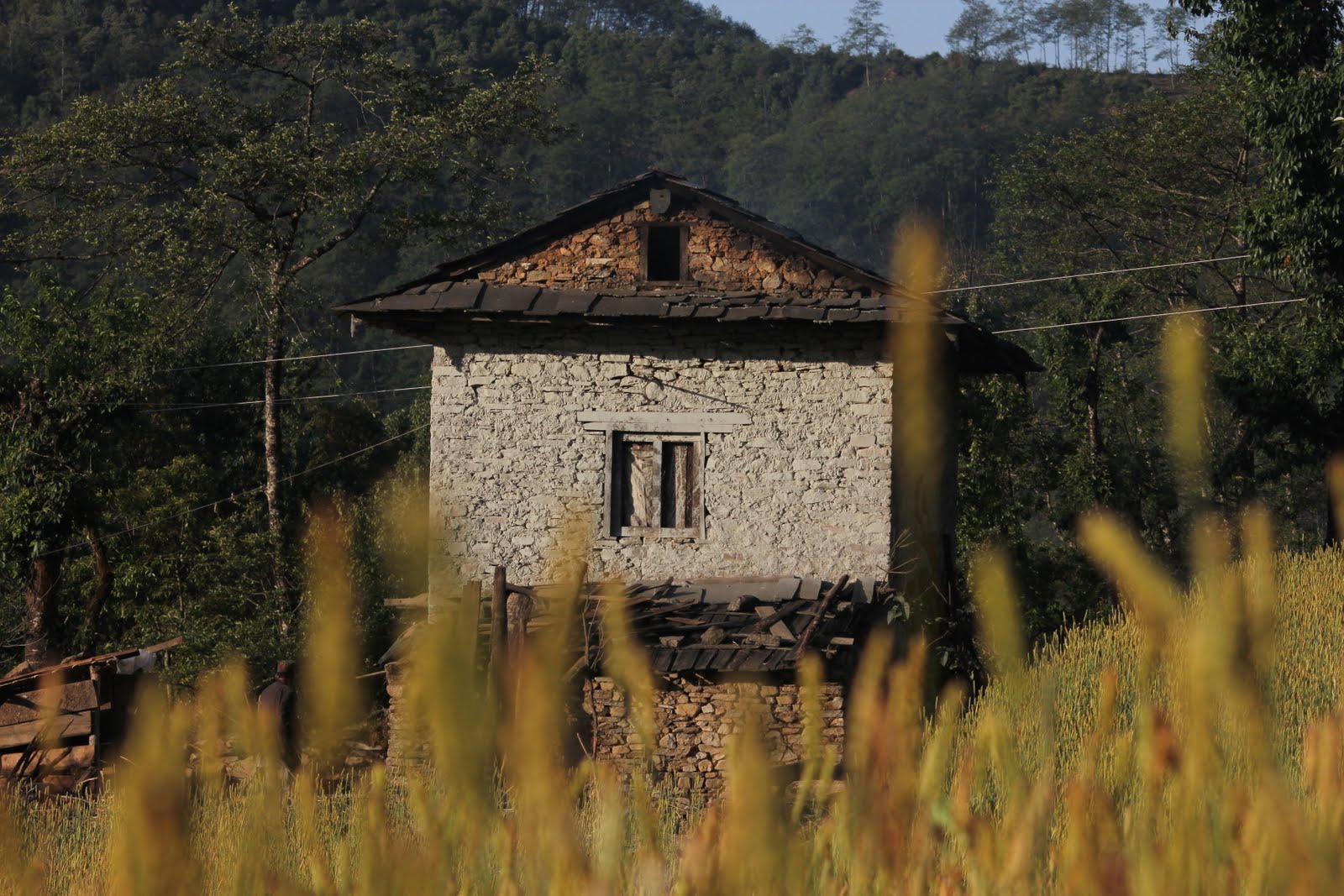
Colin and I awoke at 5am to begin our hike. Colin has a very nice DSLR camera, a Canon D60. He and I had a deal for the trek; I'd supply him with an 8 gig SD card, carry his 180mm lens, and he'd carry the body and 18mm lens, and we'd share the awesome camera throughout the trek. So we began getting up every day at 5-6am when the light is best so we could take photographs.

 |
| Photo Credit: Colin Fairbank |
We hiked for a few hours until we encountered a teahouse where we decided to grab some tea and breakfast. After the meal, the rest of the group caught up to us. We hiked another few hours until we reached the town of Kinja, where we had lunch.
After lunch, it was time to begin the grueling 1050 meter ascent to Sete. Colin and I got started behind the rest of the group, as we stayed behind to photograph the first snow-capped mountains that we'd seen on the trek.
After we'd put the awkward and bulky camera equipment away, we began the ascent. The sun was a real enemy that late in the afternoon, and caused me to pour sweat for the entire climb. I only had two liters of purified water with me, so I attempted to conserve it as best I could. Eventually I got so exhausted and dehydrated that I stopped to sip some water every time I reached some shade.
I did eventually make the top after 2 hours and 10 minutes, the third of the group to reach our destination. Colin and Dan, already at the top, were impressed with my speed as I passed several Sherpas on my way to the top. We all did our hundred pushups and had a shower.
I did eventually make the top after 2 hours and 10 minutes, the third of the group to reach our destination. Colin and Dan, already at the top, were impressed with my speed as I passed several Sherpas on my way to the top. We all did our hundred pushups and had a shower.
When I got out, I was treated to an amazing sunset.

At the guesthouse in Sete we met a very nice guide named Ngima Sherpa, who was guiding two Frenchmen from Jiri to Namche Bazaar along our same path. He didn't speak French and his clients didn't speak English, so there was obviously a little bit of tension.
We made friends with him quickly, and Wim (who speaks French) acted as a bit of a translator. Ngima Sherpa was happy to have the help, and in return, constantly gave us advice on the trail (places to stay, times, routes, etc)
Day 3: Sete to Junbesi
6-7 Hours, 1280m ascent, 1220m descent
The weather was very cold at 3500 meters, so we got on our jackets and pants and continued along the high pass to the next valley. After only 20 minutes or so of walking, we ran into Wim. He had gotten so far ahead that he stopped at a teahouse for some food. Since we had found him, we decided to stop as well and get something to eat. I was thrilled that we had a longer rest period before the descent. My muscles were in total agony.
According to our Trekking book and maps, day 3 was to be the most difficult day of the entire trip: "The first half of the day is a long and draining climb" to Lamjura, the point of highest altitude (3530m/11581ft) before reaching Sagarmatha National Park. After that is a high pass to a descent of 1220 meters into a "moss-cloaked forest of gnarled rhododendron, magnolia, maple, and birch trees."
Day 3, for me at least, would prove costly. I began a video diary that day, wanting some live-action footage of the epic trek that I was on. Watching it now, I can see my health deteriorate over the course of what felt like one of the longest days of my life.
On day 3 Wim really established himself as the strongest of the group, and he rocketed to the front of the pack and shot up the mountain, probably a good half-hour ahead of the rest of us. My muscles ached with every step I took, and I quickly fell behind Dan and Colin as well (I stayed well ahead of Eran and the girls).
I don't know of a time when my legs were more sore than that day. The ascent of day two really sapped my energy. My calves were in constant pain. There wasn't a single point of my entire body that didn't seem to hurt in a way. My hips were so sore that I'd loosen my waist strap to alleviate the pain, but then after a few minutes my shoulders (now bearing more of the burden of my 35lb pack), would ache, and I'd have to re-distribute the weight with strap adjustments.
I finally made the top, had some tea with Colin and Dan, had a rest, and tried to stretch a bit to alleviate some of the muscle pain.
 |
| No pain, no gain. Photo Credit: Colin Fairbank |
After eating, Wim the Belgian Machine (as he became known after the days' end) took off again, as did Dan, and Colin and I took our time on the rocky descent. Eventually it got too hot to continue in our jackets and pants and we had to strip back down to t-shirts and shorts.
By this time I was extremely fatigued and was beginning to feel awful. My muscles were a constant problem, but now I was wondering if I even had the ability to make it. My knees began to ache as well from the constant pounding they were taking as I made my way down the mountain. We did eventually reach the valley floor, and seeing a town just a short distance away, Colin and I stopped for a water break and to take a few more photos.
We reached the town only to discover that it was not Junbesi. We asked a couple of Sherpas along the path how far to Junbesi to which they all replied, "three hours."
This information was absolutely crushing. I didn't have much left in the tank, let alone enough for a 3-hour hike. There wasn't much I could do about it, so I sucked up the pain, threw my bag on, tightened the straps, and made my way down the trail.
After a period of just over two hours, I stopped at a teahouse completely spent. I ate a candy bar to try to get some sugar in my system, but I had no idea how much farther we had to go.
Just then, Ngima Sherpa turned up and said Junbesi was 40 minutes away. I psyched myself up for the hike, threw my pack on and took off with complete determination. Wim set a rocket pace and I kept up with him as best I could, desperately needing the day to be over. I reached Junbesi in about 30 minutes and as I approached the guesthouse I slowed down.
All of a sudden all of the pain I had been ignoring came rushing up all at once and I almost collapsed. I took off my pack as I caught up with Wim.
"Just a few more steps man, you're almost there," he said in encouragement.
I dragged myself across the entrance of the guesthouse, dropped my pack, and slumped into a chair Wim grabbed for me.
I sat outside as the rest of the group arrived, drinking tea with lots of sugar to try to get my blood sugar levels back up. After everyone made it, I walked upstairs with a good bit of difficulty, unrolled my sleeping bag, and instantly passed out. It was 5:30pm.
The team woke me up around 9 for dinner and I put on a smile to try to act a bit more normal and not so completely fucked up. Truth was I was feeling a lot better. But it didn't last long. I ate my rice and went back up to bed.
Day 4: Junbesi
I awoke at around 7am as alarms began to go off. I knew instantly something was wrong. I felt horrible and had no appetite. I told Colin and Dan, my roommates that night, that I was going to skip breakfast and stay in bed. I told them to wake me when it was time to pack and go. I hoped I'd be ok to hike and quickly passed back out.
Colin came back in the room around 8am and told me the group wasn't leaving yet and I could keep sleeping. I told him I was definitely sick and might need to stay behind, at least for a few hours. He said that wasn't a problem and said that I could take a few more hours and we'd leave later in the day when I felt better. I passed back out.
I awoke an unknown amount of time later, shivering, sweating, and shaking uncontrollably. I was determined not to fall behind and got out of my sleeping bag and began to gather my gear.
Colin walked in and saw the condition I was in.
"You ok? You don't look too good."
"I think I can make the hike today," I said, pouring sweat and shaking as I tried to put my boots on.
"No way. Get back in bed," he responded.
"Well I think--"
"I said get back in your fucking bag, mate. I'll figure something out."
He and Wim stayed behind with me that day. Wim ran up the mountain an hour and 40 minutes to tell the group I was sick and he and Colin would stay behind with me. I can't express the amount of appreciation I have for Wim and Colin for how much they helped me that day. I crawled back in bed and fell asleep.
I kept drifting in and out of consciousness for the next few hours. I began to get scared as I had cold sweats and was shaking uncontrollably. The truly disconcerting fact was that I was in the middle of nowhere; Junbesi is a two-day hike from the nearest hospital.
I began having extremely vivid dreams and hallucinations. At one point, I dreamt that I was back at my home in Maryland. In the dream, I knew that I had been sick in Nepal but couldn't remember how I got home. I was trying to convince myself was it was real and that I wasn't dreaming. I walked all around my house, checking things for normalcy. Everything seemed in place. I figured something bad must have happened in Nepal because I was suffering from amnesia and couldn't remember how I got back. I eventually concluded that I wasn't going to figure it out and I lay down on my bed, content in the comfort of my childhood home.
Then I woke up in a freezing room in Nepal, in a sleeping bag, shaking and sweating.
I began wondering if I was experiencing symptoms of malaria. I could have picked it up from bites I received in Sri Lanka or in Kathmandu. I took my temperature: 101.6.
I knew if my temperature climbed any higher or if my condition deteriorated any more, Colin and Wim would have to start considering calling in a helicopter evacuation for me.
I opened up my medical kit and began taking ibuprofen and antibiotics. Over the next two hours my fever dropped to 99.3 and then to a comforting 98.6 by the evening with no real lingering side-effects.
I have no explanation for my condition that day.
Day 5: Junbesi > Nunthala > Bupsa
5.5-6.5 Hours, 900 meter ascent, 1250 meter descent > 5-6 hours, 800 meter descent, 900 meter ascent
We had a few epic days over the course of the 17-day trek. Day 5 was certainly one of them. I woke up feeling strong and we wanted to catch up with the group. That, of course, meant doing two days worth of hiking in one. We still had a lot of the girls' shit in our packs, and gave it all away to the owners of the guesthouse, rather than carry it all the way to Bupsa
We set off that morning just after 6am.
On their day off while I was sick, Wim and Colin hung out around the guesthouse and made friends with the people working there. In particular, they befriended the 16 year-old orphan working for money for school. His yearly tuition costs less than $100, but he didn't think he'd be able to afford it more than one more year.
Wim spent a few hours helping him with his math and both he and Colin spent time helping him practice his English. As a gesture of thanks, he made us all walking sticks to help with the hike we were about to embark upon. Both Wim and Colin already had walking sticks, so they gave them to me.
They were far too heavy to use on a long hike like the one we were doing, but none of us had the heart to tell him we couldn't use them. I was determined to at least use one, in spite of the weight, to try to take some of the burden off my swelling knees.
The good news was that I felt great and my muscles weren't really sore anymore. After a slow start, I really hit my stride and powered through the first half of the hike.
It started pouring on us after a few hours, followed by a hail storm. Still, we reached Nunthala at 11:30am. We brought our clothes inside a teahouse to dry and they made us lunch and tea. It was nice to warm up and relax a bit, but we still had another full days worth of hiking ahead of us. We were supposed to be rewarded at Nunthala with our first view of Everest, but it was a view that was to elude us for another 5 days.
We powered on for a few more hours after lunch, through the mud and the rain, until the weather lifted and we were able to go back to t-shirts and shorts, far more comfortable in the humidity. I stopped to take off my rain jacket and accidentally dropped my home-made walking stick into a pile of yak shit. Oh well, I guess it had a good run. Damn thing was giving me blisters on my thumbs anyway.
We reached the town of Jubhing and happened upon a few French tourists. We were completely exhausted by this point, having already hiked for 12 hours, and Wim asked a couple of them how far to Bupsa. Upon hearing their response, he turned to us looking a bit disheartened, and said only, "I'm not translating that."
We walked for about another hour, along a steep ascent. We knew we were close, but we were all exhausted and it was getting dark. We stopped at a teahouse for a breather. I drank some tea and forced down a candy bar before what I knew would be a very steep ascent into Bupsa. As night fell around us, we put on our packs, flicked on our headlamps, and made our way up the hill and into the darkness.
I had absolutely nothing left in the tank. But I kept putting one foot in front of the other and Colin and Wim were both there to help motivate me to the top. I don't know how long it took us, but eventually we reached Bupsa. We had hiked for 14 hours.
The rest of the team came out of the guesthouse and applauded our effort, conceding that they didn't think we were actually going to make it. We walked inside, took off our sweaty gear, and warmed up.
The owner of the guesthouse was a very nice man and prepared us some food. He inquired as to why we showed up so late. When we told him we had walked from Junbesi that morning he was astounded.
He said, "I've climbed Everest twice, and I'm extremely impressed with the hike you boys just made."
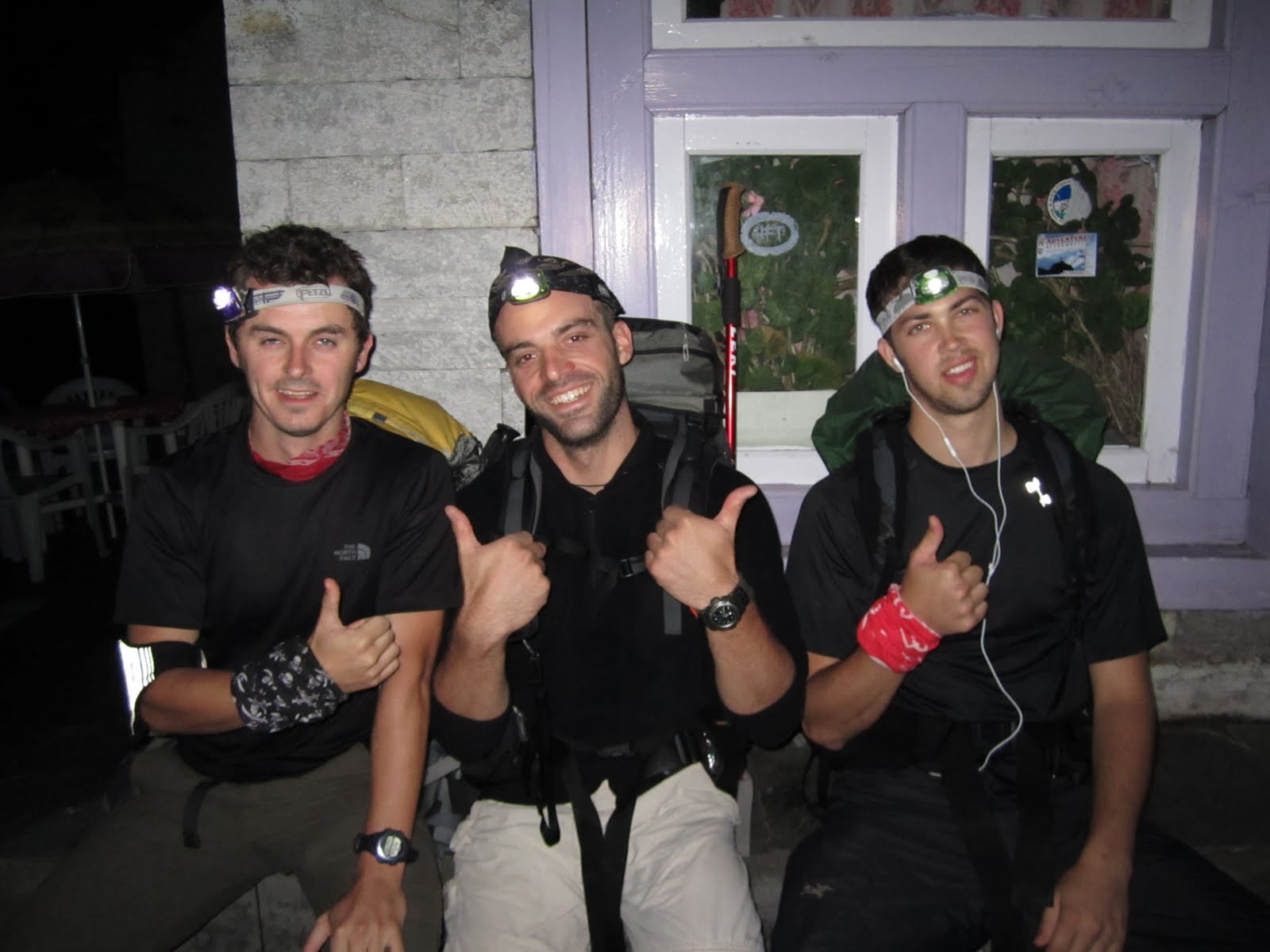 |
| From left to right: Colin, Wim, Me upon our arrival in Bupsa |
5-6 Hours, 1000 meter ascent, 650 meter descent
We were originally supposed to walk to Lukla from Bupsa, the point at which most people fly into the region. Instead, we wanted to bypass Lukla, as there was a more direct route to Namche Bazaar. With our energy levels pretty low after the 14 hour hike from the day previous, we didn't quite make it to our destination of Chheplung. Not only that, I had more bad luck in store for me.
The hike throughout the day remained pretty casual and laid back. We weren't moving at our normal let's-push-the-envelope paces. Let's face it, we were exhausted.
As the hours dragged on, we realized that it was getting late and we might not make it to our destination before dark. Not wanting a repeat of the previous days night climb, we picked up the tempo to try to see if we could make it. Some of the team members expressed concern that they weren't as fast as some of us and wanted to discuss stopping before Chheplung. I basically made the decision for everyone without intending to.
The path is always extremely rocky, and everyone inevitably comes close to tripping or twisting an ankle at some point during the day.
I don't really remember how it happened, but I looked up to see where the path was heading, lost my footing on a downhill section, and had no room to recover. I went ass over elbows right into a bunch of rocks. I was falling downhill, so my first instinct was to protect my head. I threw out my arm and pushed myself over so I landed on my backpack and not my face. Gotta protect the face...that's the money maker.
I thought I was ok, but I rolled over and blood started gushing out of my hand, knees, and shins. Eran the Israeli medic and Colin were right behind me, and we all got out our medical kits to start patching me up.
My fall took the most damage on my left hand, which I used to roll myself over. There was a quarter-sized chunk of flesh that had been gauged out, and I grabbed it and ripped the rest of it off to make room for the bandage. Once we had that sorted out, Eran got out the gauze and taped up my knees and legs. Colin gave me a codeine for the pain, and I limped another mile or so to Surke. We stopped there for the night.
Day 7: Surke to Namche Bazaar
Epic Day #2: 10 hours, 1150 meter ascent
The ascent to Namche was brutal to say the least. Long, winding, and steep, it is a grueling climb to the top. You ascend in altitude to 3420 meters (11,220 ft), 300 vertical feet shy of the top of Vail Mountain and 8 vertical feet higher than the summit of Aspen mountain, both in Colorado, USA. While skiing might be fun at that altitude, if you have any appreciation for the oxygen levels at 11,000 ft, climbing up a mountain is not an easy task.
The girls Carla and Audra told us they'd be unable to complete the hike to Namche in a day but that we should go ahead. We did.
We hiked several hours until we got our first views of Ama Dablam in the distance. Ama Dablam stands at 22,349 feet and is one of the most gorgeous mountains we saw in our time in the Himalayas. At first it was a monster way off in the distance. In a few days time we would be sleeping at her base, and yet a few days after that we'd be seeing her in the distance again, dwarfed by the shadows of Everest, Nuptse, and Lhotse. We had a view of Ama Dablam from that moment through the end of the hike and it almost became like a friend. I think I can speak for the entire team that it was our favorite mountain we saw over the course of our trek.
 |
| Ama Dablam as we approached from the Southwest. The mountain seemed to get more spectacular every day as we continued towards and eventually past it. |
At a certain point, our trail merged with the much more commercialized trail from Lukla. Lukla is the main hub from which people enter and exit the region. After going a week and seeing only a handful of people, we didn't much appreciate all the other people crowding the trail.
We also didn't realize just how much the previous 6 days had whipped us into shape. We were able to outpace and out-climb every single person we encountered for the rest of the trek. No, that is not an exaggeration. Our first bit of proof came as we ascended past Monjo to Namche.
As we entered Sagarmatha National Park, the scenery seemed to improve every step of the way. Crystal clear rivers flowed with glacial melt water. The scent of forest pine filled the air (for at least a little bit, but I'll get to that later), and massive peaks like Ama Dablam loomed off in the distance.
We ate lunch in Monjo and got our packs ready for what was supposed to be a 3.5 hour climb to Namche Bazaar.
As we ascended one particularly steep section of trail, a sweet Australian woman stopped me to ask for directions, and struck up a conversation.
"It's really steep here. Must be one hell of a climb for you," she said.
"Ah, it's not too bad, I've been hiking for a week already, the trail is worse by Sete."
"Oh wow. We flew into Lukla..."
It was about then I realized just how far I'd pushed myself in that week and how much it had paid off. We passed Sherpas, porters, guides, and every group we encountered on the hill. Colin and I didn't even need to stop. We ascended all the way from Monjo to Namche in just over two hours.
 |
| Namche Bazaar, carved into the hillside |
 |
| Shops in Namche, giving it the nickname, 'Little Thamel' |
I want to take a moment to talk about yak shit. I realize it's an odd topic, but bear with me. Yak trains cruise up and down these mountains every single day. Hundreds of them, constantly moving equipment, food, and other supplies up and down the hill. They shit everywhere. They shit constantly. Their shit smells like shit. And they always seem to shit on sections where you're climbing uphill.
You'll be sweating, panting, exerting yourself trying to move uphill with all your gear when you'll get a huge whiff of yak shit. It's not like you can cover your mouth and nose and not breathe it in. You're hiking at altitude, and sometimes it's a real struggle just to catch your breath. You have no choice but to inhale the foul odor as you ascend. You take a full breath of it. Sometimes you take a few. There's no way around it, and you never get used to it. This is one of the reasons it was so nice in those brief moments when you could smell something fresh, like forest pine.
Why can't they just shit on a downhill when you don't need to breathe it all in? I don't know. But I don't like yaks so much anymore. I really wanted to like yaks. They seemed cool. Sherpas are cool. Why can't their yaks be cool? It's not just the shit that makes me dislike yaks. It was simply the most present issue.
Anyway, I digress. I could go on all day about yak shit (joke).
We got a room at a hotel in Namche and relaxed with an Everest Lager (what a name), knowing that for the first time in a week we wouldn't have to hike the next day. We were to spend at least a day in Namche to acclimatize before ascending towards Mount Everest.
Namche to Everest Base Camp and back in my next post. The best photos from the hike were from Namche to Everest as well, all coming soon...